Quick Answer
Most soreness improves with time.
That’s what people expect.
You pull a muscle, overdo it in the yard, tweak your shoulder, or wake up with a stiff neck. A few days pass and things gradually get better.
But when several weeks go by and the pain is still there, it’s reasonable to start asking questions. Sometimes the body simply needs more time. Other times, it’s a sign that something isn’t healing the way it should.
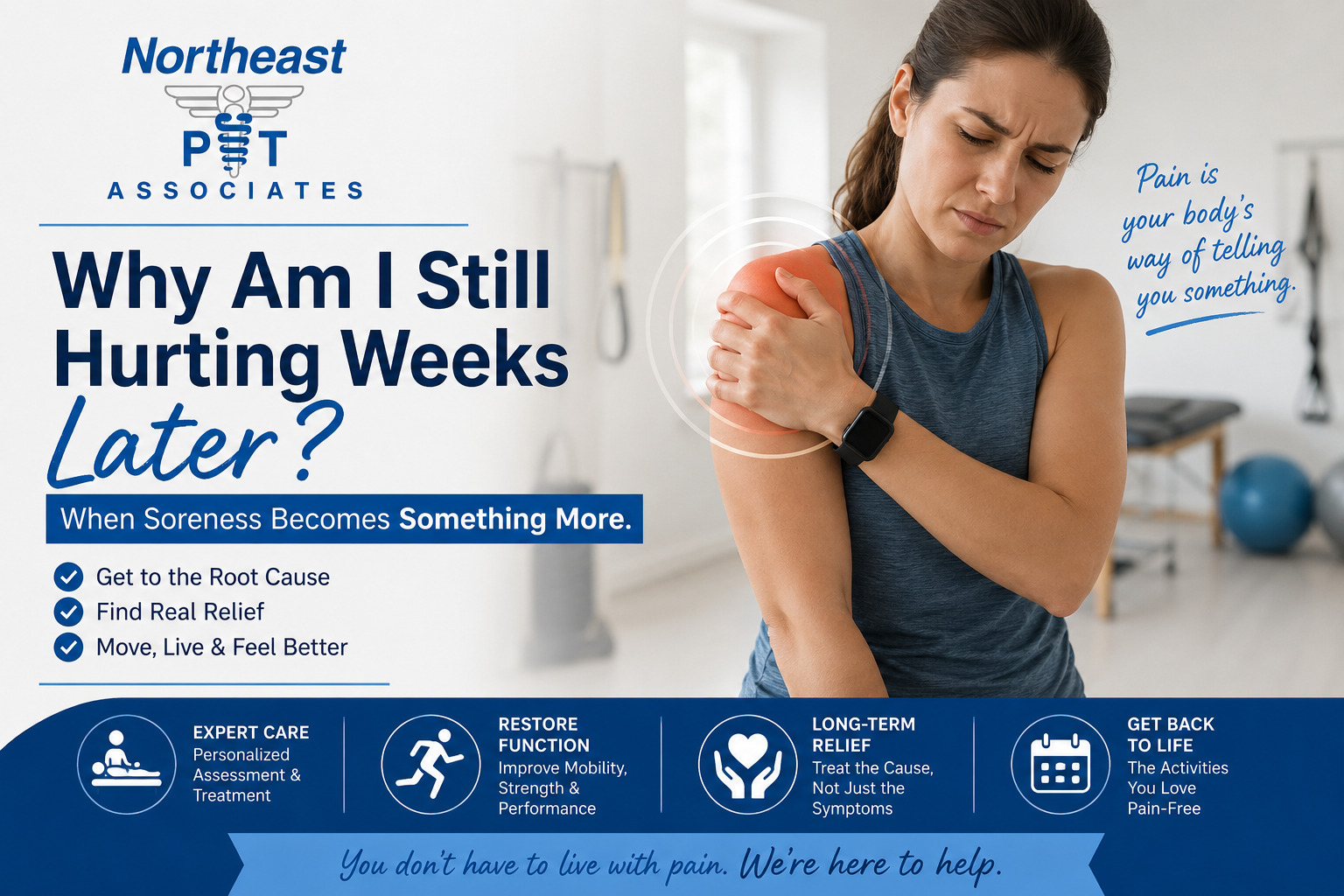
We Hear This Question All The Time
One of the most common things people tell us isn’t: “I got hurt.”
It’s: “I thought it would be gone by now.”
Many patients don’t come to Northeast Physical Therapy immediately after an injury. They wait.
And that makes sense.
Most people don’t want to rush into treatment. They expect the soreness to fade. The stiffness to improve. The movement to come back.
Sometimes it does, but sometimes it doesn’t.
That’s usually when they walk through our door.
It Started With Carrying Mulch
A gentleman from the Hazleton area came in last summer because of shoulder pain. At least that’s what he thought it was. A few weeks earlier, he had spent a Saturday hauling bags of mulch around his property.
Nothing unusual.
No dramatic injury.
No pop.
No fall.
No emergency room visit.
Just a busy weekend outside.
The shoulder felt sore afterward.
He assumed it would improve.
A week passed.
Then another.
Soon he was avoiding certain movements because they hurt.
That’s when he decided to have it looked at.
What seemed like ordinary soreness had become something that was affecting daily life. We see stories like that every week.
The Body Usually Gives Clues
One thing we’ve learned over the years is that the body tends to tell us when something isn’t right.
The problem is that people are busy and they ignore the clues.
The shoulder that still hurts reaching into a cabinet.
The knee that feels stiff every morning.
The back pain that keeps returning after a long day.
The ankle that never quite feels stable again.
None of those things may stop someone from living their life. But they’re often signs that the body hasn’t fully recovered.
Not Every Injury Gets Better With Rest
This surprises people. Many patients assume rest is always the answer, but that isn’t always true.
We’ve worked with patients throughout Newark, New York, Freeland, Easton, Mt Olive, Drums, Madison, Somerville, Maplewood, and surrounding communities who spent weeks resting an injury only to discover the problem wasn’t improving.
The issue wasn’t that they needed more rest.
The issue was that the body needed the right movement.
That’s an important distinction.
The “Good Days And Bad Days” Pattern
Another clue we hear about frequently is this: “It feels better some days.”
Then comes the second part: “But it keeps coming back.”
That’s often what frustrates people most. The pain isn’t severe enough to seem urgent, but it never completely disappears either.
A good day creates hope. A bad day creates frustration.
Several weeks later, they’re still dealing with the same problem.
That’s usually when patients begin wondering whether they should talk to someone.
What Happens When You Start Compensating?
The body is smart. Sometimes too smart.
When one area hurts, we naturally begin changing how we move. We favor one leg, shift weight differently, reach differently, walk differently.
Without realizing it, we begin compensating.
The original problem may not even be the only issue anymore. Now other muscles and joints are working harder too. That’s one reason small problems sometimes become bigger problems.
Not because the injury worsened, but because the body adapted around it.
The Question We Encourage People To Ask
Instead of asking: “Can I tolerate this?”
Ask: “Is this improving?”
Many people can tolerate discomfort. That doesn’t mean they’re recovering. Improvement is what matters.
Are you moving better than you were two weeks ago?
Is the pain occurring less often?
Are activities becoming easier?
If the answer is no, it’s worth paying attention.
The Goal Isn’t To Tough It Out
We meet a lot of hardworking people. People who are used to pushing through discomfort.
Business owners.
Parents.
Retirees.
Athletes.
Tradespeople.
They’ve spent their entire lives figuring things out on their own.
We respect that.
But there comes a point where pushing through isn’t helping. The goal isn’t proving how much pain you can tolerate. The goal is getting back to doing the things you enjoy.
What We Love To Hear
One of our favorite comments from patients is surprisingly simple: “I wish I had come sooner.”
We hear it all the time.
Not because treatment is complicated.
Not because recovery is dramatic.
Because many people spend weeks wondering whether they should seek help when they could have spent those weeks making progress.
That’s often the difference.
Clarity.
A plan.
And an understanding of what’s actually happening.
Recovery Should Feel Like Progress
Nobody expects healing to happen overnight, but most people do expect to see progress.
If weeks have passed and you’re still dealing with the same pain, stiffness, weakness, or limitations, it may be time to take a closer look.
Sometimes the solution is simple.
Sometimes it requires a little guidance.
Either way, having answers is better than guessing.
So, Is It Still Soreness?
Maybe.
Maybe not.
That’s the challenge.
The body doesn’t come with warning lights.
Pain that lingers, returns repeatedly, limits movement, or interferes with daily activities deserves attention.
At Northeast Physical Therapy, we help patients throughout Newark, New York, Freeland, Easton, Mt Olive, Drums, Madison, Somerville, Maplewood, and surrounding communities understand what’s causing their discomfort and create a plan to move forward.
Because recovery shouldn’t feel like you’re stuck in the same place month after month.
Frequently Asked Questions
How long should normal muscle soreness last?
Most muscle soreness improves within a few days to a week. Pain that continues for several weeks may deserve further evaluation.
When should I consider physical therapy?
If pain, stiffness, weakness, or mobility issues are limiting your daily activities or not improving, physical therapy may help identify the cause and create a recovery plan.
Can physical therapy help without surgery?
Yes. Many conditions improve with physical therapy and never require surgical intervention.
What types of injuries respond well to physical therapy?
Back pain, neck pain, shoulder injuries, knee problems, sports injuries, balance issues, and post-surgical recovery commonly benefit from therapy.
Is it normal for pain to come and go?
Some conditions fluctuate. However, recurring pain that never fully resolves is often worth evaluating.
Do I need a referral for physical therapy?
Requirements can vary. Contact Northeast Physical Therapy and our team can help explain your options and next steps.
At Northeast Physical Therapy, our goal is simple. We want to help people move better, feel better, and get back to the activities that matter most. Whether you’re recovering from an injury, dealing with ongoing pain, or simply frustrated that something isn’t improving, we’re here to help.